Space Travel and Health Problems

During the explorations into the galactic dimension of our reality I recently ran into an interesting interview (1,2) that Dani Henderson did in September 2026 with Beverli Rhodes who has been close to the South African contactee Elizabeth Klarer.

created with courtesy of Superman and Grok

We have spoken about the remarkable case of Elizabeth Klarer before on this website (3,4), just like we have used information from Beverli Rhodes in earlier articles (5-7). This current article is about health problems that may develop because of spending time on other planets or in spaceships. Elizabeth was forced to leave the Meton planet in the Proxima Centauri star system because her Earth body had trouble adapting to the different environmental characteristics of the planet (8).

ELENA DANAAN AND PHYSICAL PROBLEMS DUE TO SPACE TRAVEL
During a round table discussion between Dr. Salla, Elena Danaan and JP back in July 2024 this issue of health problems was discussed (11). In the excerpt below you can listen to the relevant part where Elena described that she had developed heart issues. She explains how teleportations can be quite straining on the body. She says that moving into a different frequency can make you feel dizzy and very tired afterwards. She explains that our bodies are used to the Schumann Resonance of our planet for instance, and this frequency isn’t naturally around in other places. It could be produced artificially, though, as we were told by Corey Goode in his good days (12).

She says that wehn you get out of the magnetic field of the Earth, the heart panics and stresses because it doesn’t know to which magnetic field to tune into. She says that because of this she developed heart problems, which luckily were fixed by them (13). She concludes that it takes a physical toll, and that is very hard.

Elena Danaan describes how health issued arose because of travel in space (11)

ELIZABETH KLARER
As I already mentioned in the introduction of this article, Elizabeth Klarer had to return back to Earth because her body couldn’t adapt well enough to the circumstances on that foreign planet. This might explain why all kinds of species that want to live on a particular planet decide to hybridize their genetics with those who already live on that planet: it allows them to automatically be adapted to the circumstances of a planet. For instance, a Taal colony (14) would have hybridized with a local gray species in the Sirius B (15) system, for this purpose. They would have become the T-Ashkeru (16).

Below is a short excerpt from the interview of Dani with Beverli Rhodes (1) in which Beverli provides some background to why she couldn’t stay on Meton:

Beverli Rhodes on Elizabeth Klarer’s and her getting ill on Meton (1)

JEAN-CHARLES MOYEN
When I asked Jean-Charles Moyen (17) if he could add anything on this theme of health issues in space, he shared his own experiences while he was serving as a member of the Secret Space Program. He wrote:

“Yes, Joost, As far as I’m concerned—and I’m speaking from my own experience—it all depends on the person traveling in space; we shouldn’t base our understanding on what we know here on Earth. Some people experience side effects of varying severity when they travel in space, while others do not. I think this is due to their metabolism or their energy frequency, as well as their DNA. As for me, I’ve never experienced any negative effects from my interstellar or temporal travels. And from the time I was born until now, I’ve had no physiological problems. Every case is unique, because we are all unique. We can’t make generalizations.

However, there are highly advanced technologies, such as intelligent suits (18) that regulate your cardiovascular system and blood circulation, etc., to correct any irregularities a person might experience during interstellar or time travel, since during these processes, the molecules in your body are under extreme stress. Dematerialization, rematerialization, etc.—but the technologies used in SSPs are highly advanced to prevent or circumvent this problem.” (19)

SOME REFLECTIONS
Not only Elena Danaan and Elizabeth Klarer have faced health problems due to their times in space, or possibly due to the effects of teleportations or traveling through portals. Tony Rodrigues also described how people needed time to adjust (and drink a lot!) after passing through portals. JP developed some physical problems apparently, but then again Jean-Charles Moyen did not. Corey Goode described how the Schumann Resonance was artificially simulated in order to make it more comfortable for humans for Earth. We have heard descriptions of huge space ships that have the ability to accommodate all kinds of species by mimicking their natural habit in special sections of their ship. It’s not just a problem for humans in outer space, but it probably plays a role with every species that is outside of their natural habitat.

Let’s finish this article with a quote on the Algruu Al’Ix and their health issues in space: “They don’t travel much as they need their wet gaseous life support environment, which needs to be recreated in their ships. Dryness and especially Earth sun rays can kill them by disicating their skin very badly” (20, p.188)

FOOTNOTES
(1) ELISABETH KLARER Shared Her ET Contact With Beverli Rhodes Who Shares First Contact With Off World
(2) See a thread in our Galactic Anthropology Study Group for an analysis of this video: On the Metoni from Proxima Centauri
(3) Delving into the History of the Meton: Venus, Earth and Mars (and some dinosaurs)
(4) On Meton Walls, Windows and Doors
(5) On Galactic Teeth – An Extraterrestrial Dental Exploration
(6) A Species that can Emit Light from their Forehead at Will?
(7) Smart Space Suits and Frequency Belts – Technology from the Galactic Federation of Worlds
(8) Within the Elena Danaan framework that I use on this website Meton is the homeplanet of the Metoni (9). These people themselves are descendants from the Noori (10).
(9) Having a Life Span of Two Thousand Years – The Metoni in the Proxima Centauri System
(10) The Noor and their Colonies
(11) Roundtable on Space Arks, Sleeping Giants, ET Assimilation and Mysteries of Saturn
(12) Creating Schumann Resonance to Bolster Health under Off-World Conditions
(13) See the associated thread in the Study Group for more on this? How acceptable is it that her heart problems were fixed by these people of the Galactic Federation of Worlds? See: Space Travel and Health Issues
(14) Taal Colonies in our Galaxy
(15) Sirius B (Thula)
(16) The T-Ashkeru and their Colonies
(17) You can find a long list of articles on Jean-Charles on this website. Either just search for his name in the search bar, or head for the Galactic Anthropology Library where you can find a shelf with his articles.
(18) Smart Space Suits and Frequency Belts – Technology from the Galactic Federation of Worlds
(19) See https://t.me/galactic_elena_danaan_reaearch/101683/101729 for the original source.
(20) Danaan, E. (2025) Encyclopedia Galactica, volume 2

Exploring Star System K2-148 and its Inhabitants in the Cetus Constellation

The galactic framework of Elena Danaan provides those who use it, with a very rich perspective on the possible nature of our galactic reality. The future will tell whether this framework is actually describing a true reality or not.

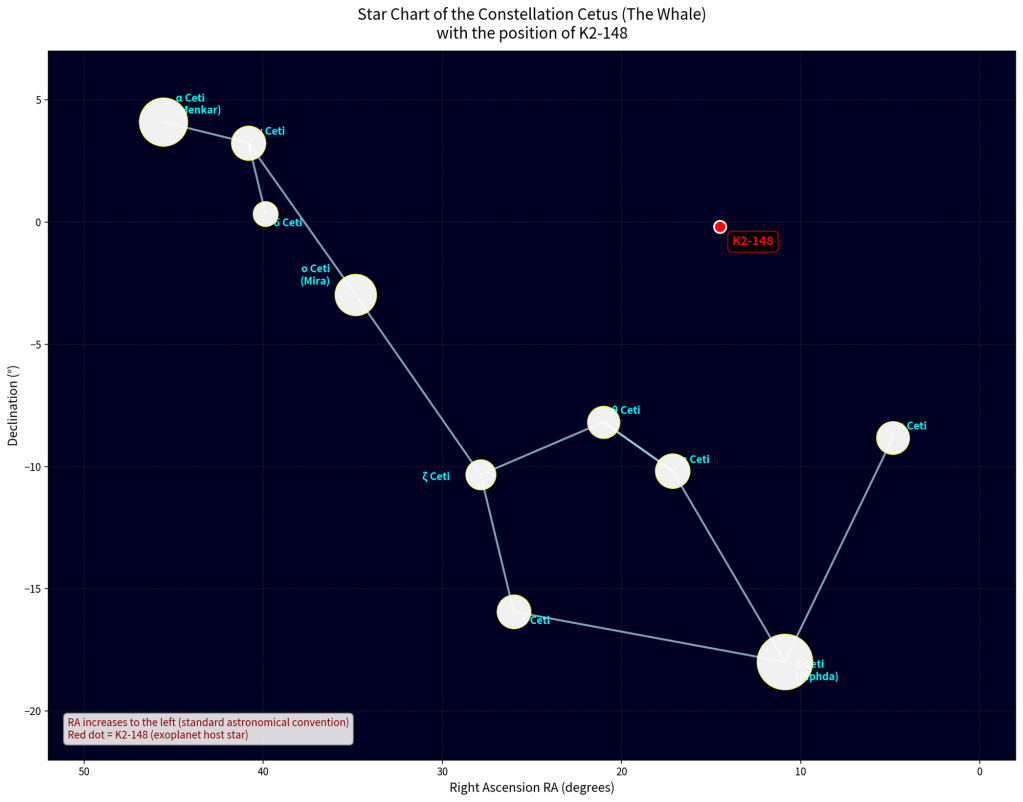
The Cetus Constellation with K2-148 (in red)

For now it gives us a chance to have a glance at what might turn out to be a reality that goes beyond our wildest dreams: our galaxy would be filled with endless species, of which many have attained the level where they can freely travel between the stars.

This website provides many examples of these species. This article focuses on three species that live on three separate planets in the K2-148 star system in the Cetus Constellation.

THE CETUS CONSTELLATION
Before we turn to that little red dot in the image on the right, I would like to link this article with earlier articles, as I usually do. The Cetus (Whale) constellation has appeared a number of times before in our galactic project. We have spoken about the people living in the Tau Ceti star system (1) for instance, like the Aramani, the Elani and the Emerther (2). Then we have the Dries (3) from Deneb Kaitos Shemali (iota Ceti) who were recently cast out of the Galactic Federation of Worlds (4,5). In (6) we briefly mentioned the ‘non-Kepler-62’-ians called the Jelliat and the Jorden who are from the Gliese 1002 star system in Cetus. The Algruu Al’ix from 3 Ceti were mentioned in the article on multiple gender species (7).

STAR SYSTEM K2-148 AND ITS THREE PLANETS
In 2018 Hirano and his colleagues published a paper (8) that detailed many results of the so-called K2-mission in regard to low mass stars. Amongst them were the discoveries of the star system at hand here, K2-148. As we can read in that paper they discovered three planets which all had very short orbital cycles of less than 10 days. In the literature these planets are called K2-148b,c and d. The star itself is called K2-148a. Let’s see what Elena has got to share on these three planets

PLANET ÜVAR
The first planet of this star system that is locally known as the Su System, is called Üvar and is inhabited by the Morghalion. In the second volume of Encyclopedia Galactica we can read: “Their planet [ ] takes 4,4 days to travel around its sun. Therefore there are no seasons on the planet.” (9, p.193)

About the Morghalion themselves we can read: “The Morghalion are humans who have developed transhumanism in a unique way. The technology that they embedded into their bodies is not of the usual sort. ….[they] started experimenting with interdimensional crystal science. They took it a step further and decided to include these crystals in their bodies, especially in their heads. As a result they became able to physically jump densities, universes and time.” (!).

They are members of the Galactic Federation of Worlds, but are said to never engage in galactic politics.

PLANET SHIVAR
The second planet is inhabited by another humanoid species that originally fled their home world in the Kepler 20 star system in the Lyra Constellation. They are called the Sorrel (9, p.195, 10). Elena describes the presence of four moons orbiting this planet. This is information that is not confirmed by the current scientific community, as of yet. It often is too complicated yet to determine if there are moons orbiting these planets that are extremely far away like these (some 405 light years) (11). It would be nice if NASA could provide confirmation on this some time in the future. That would make another corroboration for Dan’s list (12, 13).

The planet is called a Super-Earth, which means that the mass is 2 to 10 times more than our planet, but the radius of the planet is only 1 to 4 times bigger than Earth. Shivar has a mass of 3.6 times Earth.

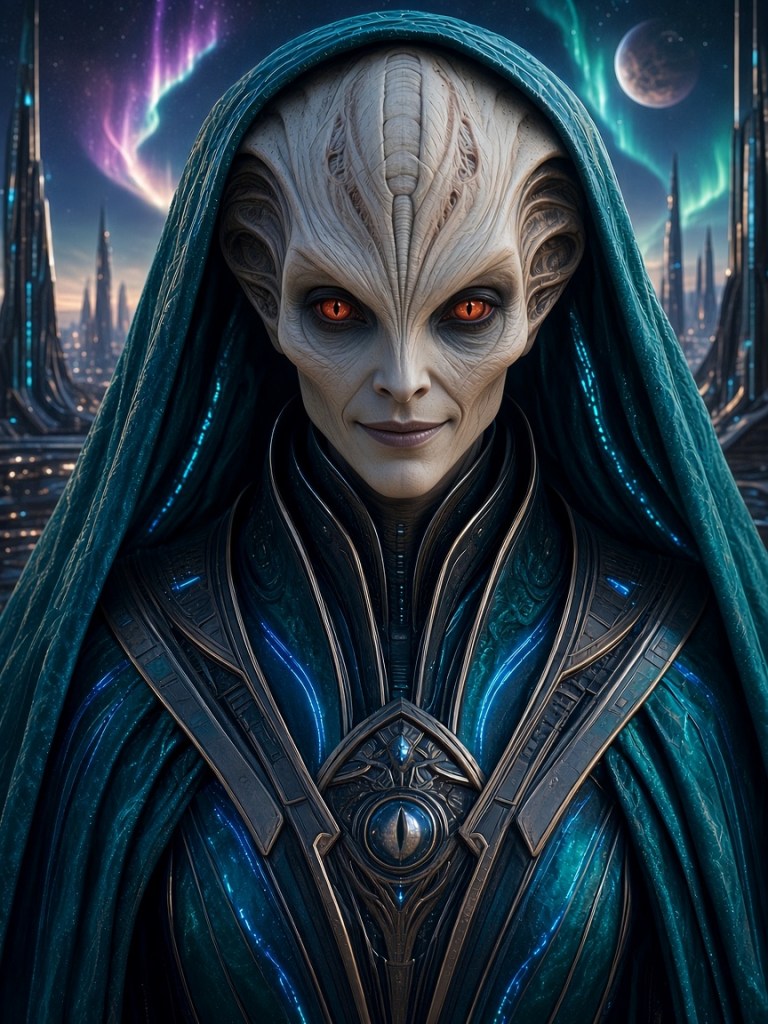
Variation on the Narkod (20)

PLANET SULLIMAR
The third planet in this lovely star system K2-148 is called Sullimar and the Narkod call this planet their home. Their planet only takes 9.8 days to orbit their star. When it comes to living conditions we can read: “Sullimar circles its parent star at a distance that, to most species would seem inhospitable. Yet the planet thrives with temperate biomes, its skies painted in soft amber tones due to the spectral hue of its cool K-type sun. Over the millenia the Narkod adapted perfectly to this world of perpetual dawns and fleeting nights, developing physiology resistant to high radiation and a culture shaped by cycles of luminous rhythm.” (9, p.196)

The crime rate on Sullimar slightly reminds me of El Salvador under president Nayib Bukele (17): “Laws are very strict, especially regarding visiting traders. There is no drug use, prostitution, slave trade or weapon smuggling. The crime rate is extremely low due to drastic penalties. There are no costly prisons here, only death sentences.”

Despite that Elena describes the Nakod as very nice, well-educated and highly intelligent people. Just like the people on the other two planets in their system they are members of the Galactic Federations of Worlds (5).

SOME REFLECTIONS
It can be interesting to occasionally compare the information from Elena’s Danaan’s star data with those from regular astronomical journals. In this case the number of planets matched completely, but in the case of the Alpha Centauri trinary system it doesn’t. Although the Proxima Centauri star is said to hold three planets (12,14,15), the total trinary system is said to hold seven planets (18), with four of them orbiting either Alpha Centauri A and B. Currently the scientific community hasn’t found any planet in the Alpha Centauri A or B system. It would be great corroboration if indeed some day these four planets would be detected. We already know who is living on them 🙂

If you like exploring these galactic territories with other, consider joining one of our groups (19).

FOOTNOTES
(1) Tau Ceti Time
(2) The Emerther are members of the Council of Alnilam
(3) On the Dries from the Cetus Constellation
(4) Former Members of the Galactic Federation of Worlds
(5) The Galactic Federation of Worlds
(6) Humanoids not Stemming from Kepler 62 in Lyra
(7) The Three (real) Genders of the Strom from Ursa Minor (and some other multiple Gender Species)
(8) Hirano, T., Dai, F., Gandolfi, D., et al. (2018) Exoplanets around Low-mass Stars Unveiled by K2. The Astronomical Journal, 155, 127 (Teruyuki Hirano et al 2018 AJ 155 127)
(9) Danaan, E. (2025) Encyclopedia Galactica, volume 2 
(10) Humanoids not Stemming from Kepler 62 in Lyra
(11) Is there anything known about moons orbiting the planets in the K2-148 star system in the constellation of Cetus? (Grok Q&A)
(12) Analysis of information provided by Elena Danaan – One of the related elements in this list is the one where Elena Danaan already drew three planets in the Proxima Centauri star system in her book A Gift from the Stars (14) when ESO only discovered a third planet two years later in 2022. See #10 in the list. Critics, however, point to a preprint scientific article from May 2020, that suggested the existence of a third planet in the wake of the discovery of the second planet (see (14,15)).
(13) List of Evidence (copy of (12) on Elena Danaan’s own website)
(14) Revisiting Proxima with ESPRESSO
(15) ESPRESSO confirms the presence of an Earth-sized planet around the nearest star (Update)
(16) https://grok.com/share/bGVnYWN5LWNvcHk_26440a59-76a9-49c3-8657-4cdc5d19f312 – Super Earth
(17) Nayib Bukele (grokipedia)
(18) How many planets are there in the Alpha Centauri trinary star system? (Grok)
(19) Telegram groups: Galactic Anthropology (general updates), Galactic Anthropology Study Group (most active group with hundreds of separate discussion topics) Alex Collier Study Group and the Galactic Anthropology Library. Elena Danaan also has her own telegram channel and even her own open telegram chat group. Dr. Salla also runs a Telegram Group. Do you want to help with studying and exposing the Deep State? Join the Gondolath Globalist Narratives Study Group or visit the website: Gondolath Project. You can also follow the alternative side of current events at the Laura Aboli Archive. There’s also a huge Epstein Who-is-who group that you can join. Galactic Anthropology tries to spread both the disclosure information and the Deep State Explorations at Reddit, Facebook, X (Twitter), on VK, Youtube and on TikTok. Hope to see you soon in one of the groups! Like, share and subscribe.
(20) Elena Danaan is quite tight when it comes to copyright, and I want to respect that. That’s why I try to solely use images and drawings that were also publicly shared, either on her website or in youtube videos. Sometimes I take Elena’s original picture and play around with it to make something different of it, but still close enough for it be recognizable. This way I am not infringing on her copyright. Of course I would have preferred to use the original one, but unfortunately Elena refuses to cooperate with Galactic Anthropology, so I try to make the best of it.