The Abductions by extraterrestrial species is a theme we have covered a number of times before on this website. There seem to be benevolent (1), relatively neutral (2) and way more malevolent kinds of abductions (3-5). Then there would also be this category related to milab experiments (6).
Within the framework of Elena Danaan many of these abductions would have been part of a huge hybridization program, where women were used in the process of creating millions if not billions of Gray-Human hybrids (7). Besides this hybridization program, people would als have been abducted for ‘programming’ purposes.
The main goal of this programming would have been to prepare humanity for these Grays and their hybrids; to make sure that they would be accepted and even welcomed (8).
The focus of this article is to highlight the flaws in the programming by mostly these Nebu Grays (9). It turns out that their methods were far from perfect and all kinds of ‘leaking’ occurred because every human brain is different and each person apparently responds differently to the programming.
In an interview with Jezya, a trade ambassador for the Kiily Tokurt (10), we were given all kinds of details surrounding these abductions and the flaws in them. The Kiily Tokurt themselves were not involved in these programming ‘classes’. Their main role involved the human slave and food trade (11).
Let’s listen to the relevant part of episode 123 from Star Nation News (12):
The Kiily Tokurt Jezya describes details regarding the flaws in the programming by the Grays (12)
ON THE FLAWS IN THE PROGRAMMING What follows is the transcript of the above video excerpt.
“Elena: Why do some people remember symbols, sacred geometry, fractals or what they describe as codes of consciousness, while others remember almost nothing?
Jezya: Because no two human brains process the conditioning identically. The subjects were not supposed to remember the procedure consciously, but the human mind proved considerably more intricate than the Nebu’s model anticipated.
Elena: So the system was imperfect?
Jezya: Far from it. Over time, we concluded that the Dominion’s methodology contained several significant flaws. Memories leaked through, images resurfaced, dreams reconstructed fragments. Sometimes the conscious mind attempted to give form to information it had never been meant to perceive directly.
Elena: What form?
Jezya: Geometry frequently. […] The programming data embedded within the frequency keys were perceived by the human mind as holographic geometrical structures, patterns, symbols, fractals, sequences. What one individual remembered as a symbol, another might experience as a dream, a sound, an intuition, or nothing consciously accessible at all.” (12)
SOME REFLECTIONS It’s not easy to get a grip on these matters related to abductions, mind control, mind programming and mind wiping techniques. I hope to contribute to a better understanding by describing various elements. In earlier articles we spoke about how curses and mental ‘booby traps’ would be installed in order to make sure people wouldn’t remember certain information (13). Mind wipe techiques would have been used in the various 20-year and back programs (14), and apparently these mind wipe programs weren’t 100% successful either, since we have heard quite a few testimonies from people who participated in those programs (15).
Well, it’s good to know that not all people fall for these mind programming/wiping techniques and that we are ‘more intricate than anticipated’ as Jezya described it 🙂
If you reflecting about these topics, make sure to join our Galactic Anthropology Study Group (16)
During the explorations into the galactic dimension of our reality I recently ran into an interesting interview (1,2) that Dani Henderson did in September 2026 with Beverli Rhodes who has been close to the South African contactee Elizabeth Klarer.
created with courtesy of Superman and Grok
We have spoken about the remarkable case of Elizabeth Klarer before on this website (3,4), just like we have used information from Beverli Rhodes in earlier articles (5-7). This current article is about health problems that may develop because of spending time on other planets or in spaceships. Elizabeth was forced to leave the Meton planet in the Proxima Centauri star system because her Earth body had trouble adapting to the different environmental characteristics of the planet (8).
ELENA DANAAN AND PHYSICAL PROBLEMS DUE TO SPACE TRAVEL During a round table discussion between Dr. Salla, Elena Danaan and JP back in July 2024 this issue of health problems was discussed (11). In the excerpt below you can listen to the relevant part where Elena described that she had developed heart issues. She explains how teleportations can be quite straining on the body. She says that moving into a different frequency can make you feel dizzy and very tired afterwards. She explains that our bodies are used to the Schumann Resonance of our planet for instance, and this frequency isn’t naturally around in other places. It could be produced artificially, though, as we were told by Corey Goode in his good days (12).
She says that wehn you get out of the magnetic field of the Earth, the heart panics and stresses because it doesn’t know to which magnetic field to tune into. She says that because of this she developed heart problems, which luckily were fixed by them (13). She concludes that it takes a physical toll, and that is very hard.
Elena Danaan describes how health issued arose because of travel in space (11)
ELIZABETH KLARER As I already mentioned in the introduction of this article, Elizabeth Klarer had to return back to Earth because her body couldn’t adapt well enough to the circumstances on that foreign planet. This might explain why all kinds of species that want to live on a particular planet decide to hybridize their genetics with those who already live on that planet: it allows them to automatically be adapted to the circumstances of a planet. For instance, a Taal colony (14) would have hybridized with a local gray species in the Sirius B (15) system, for this purpose. They would have become the T-Ashkeru (16).
Below is a short excerpt from the interview of Dani with Beverli Rhodes (1) in which Beverli provides some background to why she couldn’t stay on Meton:
Beverli Rhodes on Elizabeth Klarer’s and her getting ill on Meton (1)
JEAN-CHARLES MOYEN When I asked Jean-Charles Moyen (17) if he could add anything on this theme of health issues in space, he shared his own experiences while he was serving as a member of the Secret Space Program. He wrote:
“Yes, Joost, As far as I’m concerned—and I’m speaking from my own experience—it all depends on the person traveling in space; we shouldn’t base our understanding on what we know here on Earth. Some people experience side effects of varying severity when they travel in space, while others do not. I think this is due to their metabolism or their energy frequency, as well as their DNA. As for me, I’ve never experienced any negative effects from my interstellar or temporal travels. And from the time I was born until now, I’ve had no physiological problems. Every case is unique, because we are all unique. We can’t make generalizations.
However, there are highly advanced technologies, such as intelligent suits (18) that regulate your cardiovascular system and blood circulation, etc., to correct any irregularities a person might experience during interstellar or time travel, since during these processes, the molecules in your body are under extreme stress. Dematerialization, rematerialization, etc.—but the technologies used in SSPs are highly advanced to prevent or circumvent this problem.” (19)
SOME REFLECTIONS Not only Elena Danaan and Elizabeth Klarer have faced health problems due to their times in space, or possibly due to the effects of teleportations or traveling through portals. Tony Rodrigues also described how people needed time to adjust (and drink a lot!) after passing through portals. JP developed some physical problems apparently, but then again Jean-Charles Moyen did not. Corey Goode described how the Schumann Resonance was artificially simulated in order to make it more comfortable for humans for Earth. We have heard descriptions of huge space ships that have the ability to accommodate all kinds of species by mimicking their natural habit in special sections of their ship. It’s not just a problem for humans in outer space, but it probably plays a role with every species that is outside of their natural habitat.
Let’s finish this article with a quote on the Algruu Al’Ix and their health issues in space: “They don’t travel much as they need their wet gaseous life support environment, which needs to be recreated in their ships. Dryness and especially Earth sun rays can kill them by disicating their skin very badly” (20, p.188)
The galactic framework of Elena Danaan provides those who use it, with a very rich perspective on the possible nature of our galactic reality. The future will tell whether this framework is actually describing a true reality or not.
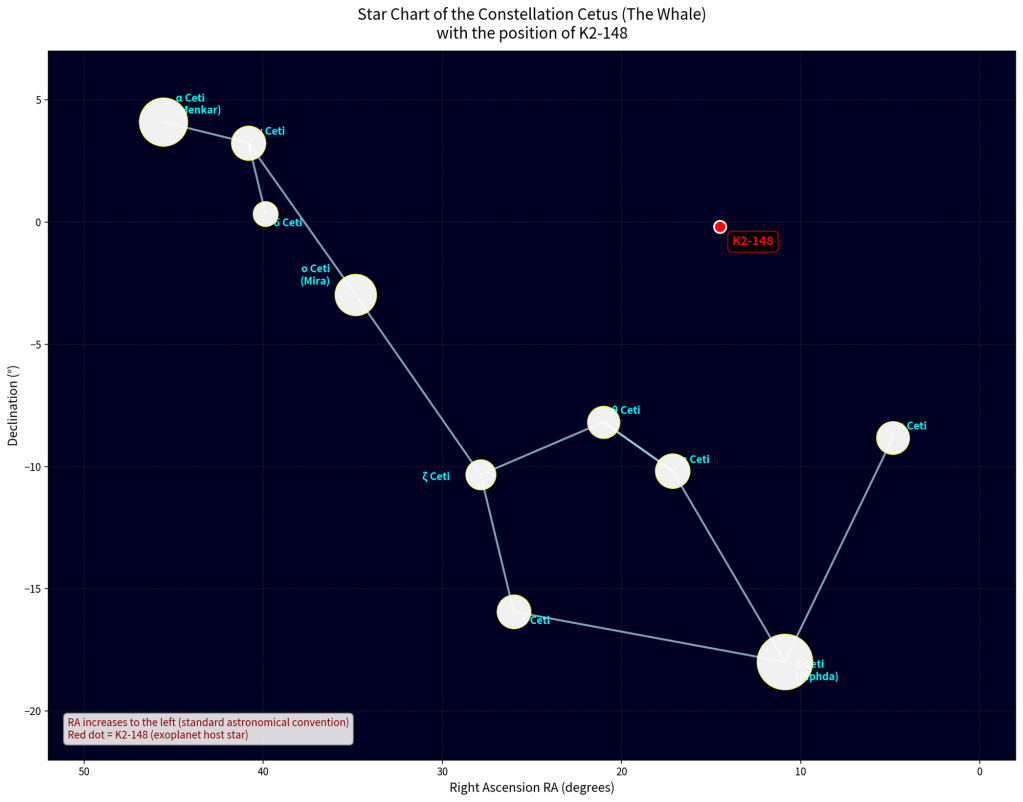
The Cetus Constellation with K2-148 (in red)
For now it gives us a chance to have a glance at what might turn out to be a reality that goes beyond our wildest dreams: our galaxy would be filled with endless species, of which many have attained the level where they can freely travel between the stars.
This website provides many examples of these species. This article focuses on three species that live on three separate planets in the K2-148 star system in the Cetus Constellation.
THE CETUS CONSTELLATION Before we turn to that little red dot in the image on the right, I would like to link this article with earlier articles, as I usually do. The Cetus (Whale) constellation has appeared a number of times before in our galactic project. We have spoken about the people living in the Tau Ceti star system (1) for instance, like the Aramani, the Elani and the Emerther (2). Then we have the Dries (3) from Deneb Kaitos Shemali (iota Ceti) who were recently cast out of the Galactic Federation of Worlds (4,5). In (6) we briefly mentioned the ‘non-Kepler-62’-ians called the Jelliat and the Jorden who are from the Gliese 1002 star system in Cetus. The Algruu Al’ix from 3 Ceti were mentioned in the article on multiple gender species (7).
STAR SYSTEM K2-148 AND ITS THREE PLANETS In 2018 Hirano and his colleagues published a paper (8) that detailed many results of the so-called K2-mission in regard to low mass stars. Amongst them were the discoveries of the star system at hand here, K2-148. As we can read in that paper they discovered three planets which all had very short orbital cycles of less than 10 days. In the literature these planets are called K2-148b,c and d. The star itself is called K2-148a. Let’s see what Elena has got to share on these three planets
PLANET ÜVAR The first planet of this star system that is locally known as the Su System, is called Üvar and is inhabited by the Morghalion. In the second volume of Encyclopedia Galactica we can read: “Their planet [ ] takes 4,4 days to travel around its sun. Therefore there are no seasons on the planet.” (9, p.193)
About the Morghalion themselves we can read: “The Morghalion are humans who have developed transhumanism in a unique way. The technology that they embedded into their bodies is not of the usual sort. ….[they] started experimenting with interdimensional crystal science. They took it a step further and decided to include these crystals in their bodies, especially in their heads. As a result they became able to physically jump densities, universes and time.” (!).
They are members of the Galactic Federation of Worlds, but are said to never engage in galactic politics.
PLANET SHIVAR The second planet is inhabited by another humanoid species that originally fled their home world in the Kepler 20 star system in the Lyra Constellation. They are called the Sorrel (9, p.195, 10). Elena describes the presence of four moons orbiting this planet. This is information that is not confirmed by the current scientific community, as of yet. It often is too complicated yet to determine if there are moons orbiting these planets that are extremely far away like these (some 405 light years) (11). It would be nice if NASA could provide confirmation on this some time in the future. That would make another corroboration for Dan’s list (12, 13).
The planet is called a Super-Earth, which means that the mass is 2 to 10 times more than our planet, but the radius of the planet is only 1 to 4 times bigger than Earth. Shivar has a mass of 3.6 times Earth.
Variation on the Narkod (20)
PLANET SULLIMAR The third planet in this lovely star system K2-148 is called Sullimar and the Narkod call this planet their home. Their planet only takes 9.8 days to orbit their star. When it comes to living conditions we can read: “Sullimar circles its parent star at a distance that, to most species would seem inhospitable. Yet the planet thrives with temperate biomes, its skies painted in soft amber tones due to the spectral hue of its cool K-type sun. Over the millenia the Narkod adapted perfectly to this world of perpetual dawns and fleeting nights, developing physiology resistant to high radiation and a culture shaped by cycles of luminous rhythm.” (9, p.196)
The crime rate on Sullimar slightly reminds me of El Salvador under president Nayib Bukele (17): “Laws are very strict, especially regarding visiting traders. There is no drug use, prostitution, slave trade or weapon smuggling. The crime rate is extremely low due to drastic penalties. There are no costly prisons here, only death sentences.”
Despite that Elena describes the Nakod as very nice, well-educated and highly intelligent people. Just like the people on the other two planets in their system they are members of the Galactic Federations of Worlds (5).
SOME REFLECTIONS It can be interesting to occasionally compare the information from Elena’s Danaan’s star data with those from regular astronomical journals. In this case the number of planets matched completely, but in the case of the Alpha Centauri trinary system it doesn’t. Although the Proxima Centauri star is said to hold three planets (12,14,15), the total trinary system is said to hold seven planets (18), with four of them orbiting either Alpha Centauri A and B. Currently the scientific community hasn’t found any planet in the Alpha Centauri A or B system. It would be great corroboration if indeed some day these four planets would be detected. We already know who is living on them 🙂
If you like exploring these galactic territories with other, consider joining one of our groups (19).
Our latest article (1) dealt with a number of civilizations that were on their way towards membership of the Galactic Federation of Worlds (2). This article summarizes the people who were removed from the organization, because of undesirable behavior. In Encyclopedia Galactica volume 2, we can learn about a fairly recent development regarding the ouster of the Dries from the Cetus Constellation (3). Not too long ago a particular Anunnaki colony was given the boot after it was understood that their cooperation with the Dark Fleet and the Nazi’s have been a bit too enthusiastic. As always, other species will be added to this summary as soon as I come across them. If you happen to know of people who were former members, don’t hesitate to contact me through this website (4) or by joining our Study Group on Telegram (5).
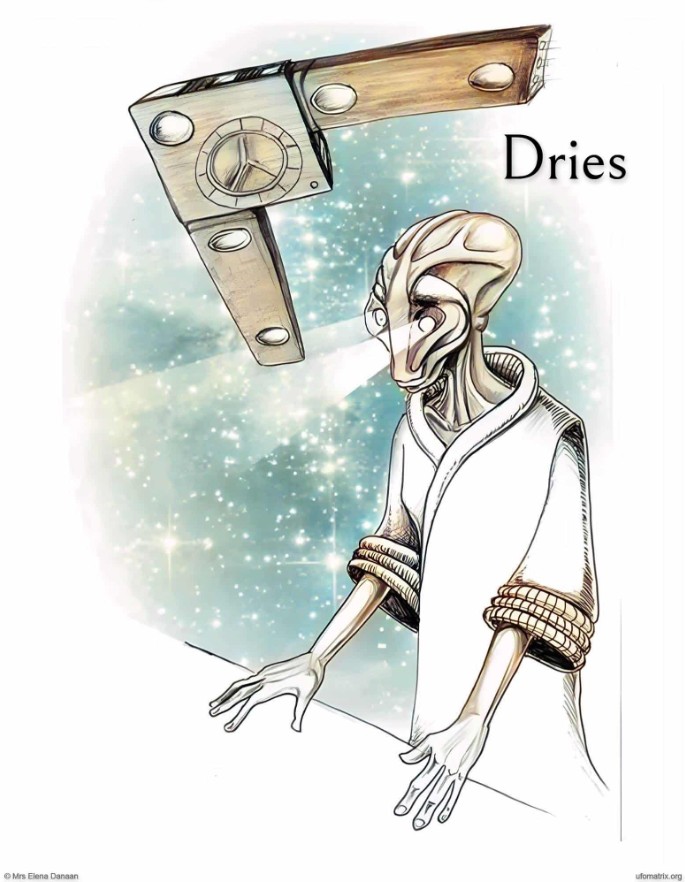
colored adapted version from Elena’s original drawing of the Dries (8, p. 133) (9)
The philosophy of the Galactic Federation of Worlds (GFW) is to even entice dubious species to join them, in order to, more or less ‘tame’ them: if they want to benefit from the military protection of the GFW, and use their huge trade opportunities, they need to end certain undesirable behavior, like slave- and weapon trade. In August 2026 (6) we were told about some 16 million people that would have been abducted by the Kiily Tokurt alone, often for food for their Ciakahrr buddies (7). Luckily this doesn’t fit within the ethical code of the Galactic Federation of Worlds.
Let’s take a closer look at the species involved.
THE DRIES We have a separate page on this nasty species that lives in the star system Deneb Kaitos Shemali (Iota Ceti), that is locally known as the Aghraban System (3). I recommend reading that page to get more details. I will only mention the relevant part related to their ouster.
“They planned to reveal themselves in 2022, however, thanks to the Galactic Federation of Worlds (2), all invasive operations were stopped when the Nebu (6) and the Ciakahrr (7) were expelled from Sol and the Orion hive was destroyed. The Dries are no longer part of the Galactic Federation of Worlds, although they were for a short time, before their practices got them kicked out.” (24, p.190)
These practices had to do with abductions and slave trade. They also have this tendency to want to conquer new worlds to expand their ’empire’.
The Jadai-Anunnaki/Anach Colony in Aldebaran, who turned out to have remained loyal to Enlil (12,17) According to unverified sources the name of the lady above is Sinead O’ Jadai
THE JADAI ANUNNAKI COLONY FROM ALDEBARAN The Anunnaki would have played a huge role in our history. You can read a lot about them on this website (10). They would also have colonized many worlds in our galaxy, just like so many other species have done (11). Normally I don’t quote from other pages of this website, since I prefer to link to them, I will make an exception now:
“THE EXPULSION OF THE ALDEBARAN ANUNNAKI FROM THE GALACTIC FEDERATION OF WORLDS As both Alex Collier and Elena Danaan have said, this Anunnaki group from Aldebaran was removed from the Galactic Federation of Worlds in July 2022. Until then they were given the benefit of the doubt, but their link with the Dark Fleet was suspicious. Apparently it was discovered that certain forces from the Dark Fleet have fled to the planet of the Anunnaki in Aldebaran/Jada, which tipped the already questionable balance of trust to the disadvantage of this Anunnaki-group.
They accepted the ruling and removed their spaceships from the fleet of the Galactic Federation of Worlds to return home. Not only were the Anunnaki-groups removed from the Federation, but the Ahel-group on another planet orbiting Aldebaran were also not welcome anymore either, since they have assisted their Aldebaran neigbors in their ‘dark’ affairs.”
THE JADAIAHIL – AN AHEL COLONY FROM ALDEBARAN As you can read in the above quote in the Anach/Anunnaki section there was also a blond Nordic-looking Ahel Colony (13) involved with these dubious practices related to the Dark Fleet (14). This is not the first time that we hear of certain Nordic looking people who aren’t as friendly and nice as they may seem (15). On her own website (16), Elena explains the various different categories of Nordic-looking extraterrestrials. She also mentions these blondes from the Aldebaran system (in the Taurus Constellation) as being part of the ‘Aldebaran Collective’:
“Aldebaran Collective – Taurus. Nordic-looking humans associated with the Jadai, a dark faction of the Anunnaki settled in the Aldebaran star system. Allies to the Ciakahrr Empire, they are also active members of the Dark Fleet, which actually has its headquarters in the Aldebaran star system. This collective has been working closely with the Nazi’s and provided them with technology such as blueprints for the Haunebu flying saucer crafts.” (16)
SOME REFLECTIONS So far it seems that the Galactic Federation of Worlds didn’t make a lot of errors of judgment. They are careful in allowing in new civilizations (1), but when things really don’t work out, they are not hesitant to simply remove peoples from their organization. Sometimes certain ‘Star Nations’ don’t want to join the Galactic Federation of Worlds themselves, but they are willing to join a rather new organization in our Galaxy, known as the United Galactic Alliance (18). This is a kind of galactic umbrella alliance that comprises the Galactic Federation of Worlds, but also other alliances and councils, like the Andromeda Council (19) , The Asthar Command (20), the Council of Alnilam (21), the Anach Empire and recently even the Arek joined (22).
If you are fascinated with all this galactic information, consider joining one of our groups, like the GA Study Group (23).
The Galactic Federation of Worlds (1) is a huge organization with a large number of stellar civilization members. They keep on expanding, allowing in new stage 3 civilizations (2), with the Gnomopo being one of the most impressive new additions (3), with even more impressive results when it comes to the cleansing of our galaxy from these Ciakahrr creeps (4). Not every civilization gets a complete membership, however. Some of them need to first prove themselves to be worthy of membership. This page presents a few ‘star nations’ that are in a probation period.
Some planets are being monitored more closely by the GFW
PLANET EARTH In 2021 we were told that our planet would be in some kind of probation period for GFW membership. You can read more details elsewhere on this website (5). At the time we could hear Thor Han (6) say: “Terra has entered a probation period to join membership with the Galactic Federation of Worlds. This is not limited in time, but the sooner the better. It was also decided that the Intergalactic Confederation will take care of leading the operations of civilian contacts, by increasing slowly the sightings of their ships in our skies, in a very organized way, following a plan.” (7)
In order to make this move towards becoming a member of this Galactic Federation of Worlds, we would first need to be able to get our own act together, with the defeat of the Global Deep State appearing to be one of the conditions for entry. When the forces that would have manipulated us for ages have been defeated we would have been a big step forward to entering our own star trek future.
THE OZURMAH On page 175 of the second volume of Encyclopedia Galactica (8) we can read the following on a human species in the Cepheus Constellation, called the Ozurmah that clearly relates to the topic of this article:
“The Ozurmah culture is a human civilization that has just achieved interstellar status, but has not yet attained planetary peaceful unity. For this reason alone, they are still on probation….The Ozurmah have not yet achieved planetary unity due to their societal organization into 465 tribal territories (!!!), each with their own leader and no councils. Most of these territories comete with each other economically and technologically. The Ozurmah have 14 orbital stations and 6 space fleets, but none of them are coordinated. The Faron situation is an issue because they exemplify the various ways a civilization can enter the interstellar domain without automatically becoming a planetary confederation.” (8, p.175)
THE TRAE Another civilization in the same constellation, but living in a different star system (HD 216520, locally known as Sta Onma) are the Trae. They are also a human culture who are in a probation period. The reason for this is different from that of the Ozurmah. Planetary unity is not an issue for them. The also only recently joined the GFW and didn’t seem to have done very good so far.
They would have become quite enthusiastic when they turned into a star faring world and managed to get rich very fast. It, however, turned out that much of their wealth was accrued by engaging in the slave trade, which is forbidden within the GFW. They eagerly worked with the Kiily Tokurt (9) at the time. They have told the GFW that they would have stopped these practices, but the GFW is not sure they are really being honest.
You can read more about the Trae at (8, pages 170-171).
THE CARYA VELDA An intriguing species with four arms (!) are the Carya Velda from the Chamaeleon Constellation. They are said to have only recently become part of the Galactic Federation of Worlds and they would be under close observation, since “they walk the narrow path between their warrior instinct and the higher understanding that true mastery lies in self-control” (8, p.218). These Carya Velda have featured in Star Nation News episode 105 (12). They also appear in A Gift from the Stars (Here’s the excerpt taken from that episode. I want to thank Elena and her sister for allowing us to get an idea of this remarkable species:
Carya Velda from SNN 105 (12)
SOME REFLECTIONS It’s interesting to see that there apparently are civilizations that have reached the interstellar stage and who want to join the Galactic Federation of Worlds, but are not getting full-fledged membership immediately. Sometimes there are reasons to monitor certain civilizations with more care, in order to determine if they really are fit for membership. One of the criteria, normally, is that there is no in-fighting on the planet of residence, just like slave- and weapon trade is prohibited, just like any attempts to invade or hunt people on other worlds is not allowed.
We have seen examples of how certain species whose tendency to hunt has become almost ingrained into their genetics, are still allowed to be members of the Galactic Federation of Worlds, under the condition that the hunting is restricted to their own world (10).
If you like reflecting on the ins and outs of this fascinating paradigm, consider joining our study group or one of the related groups (11).
In 2025 Congresswoman Anna Paulina Luna used the term ‘Interdimensionals‘ to describe certain beings that she and other people from Congress were shown evidence of (1). What to make of this term? What do we know about dimensions and species from other dimensions? How does the term ‘density’ relate to this? This article presents some valuable background to get a better understanding of these terms that explore new and exciting galactic territory.
DIMENSIONS AND DENSITIES Within the framework of this galactic exploration website we use certain terminology to describe matters. If we want to develop a better understanding of what ‘interdimensionals‘ might be, relatively clear definitions are crucial. I use the terminology used by Elena Danaan since she provides the most extensive and practical galactic toolkit, in my opinion. She has a rather straightforward definition namely that a dimension is a (parallel) universe, or a whole connected reality.
Every dimension is made up of several frequency layers or densities. Elena describes a dimension as a multi-storey building where each floor represents a different density. Our dimension would consist of 13 of such density layers, but other dimensions can have a different number of densities. Take a look a (2) to hear her explain it herself. But what is a density, really?
The physical world that we live in on our planet is called the third density that has a particular frequency of the movement of physical matter that neatly matches with the ability of our eyes to see it: it seems as if everything that we can see and touch is perfectly adapted to each other. If our bodies would have a higher frequency we would simply pass through the matter around us; if our eyes would have been tuned to frequencies only a bit higher than the visible light we wouldn’t see a thing of our material world. A precarious frequency balance is needed for us to live comfortably in our physical third density.
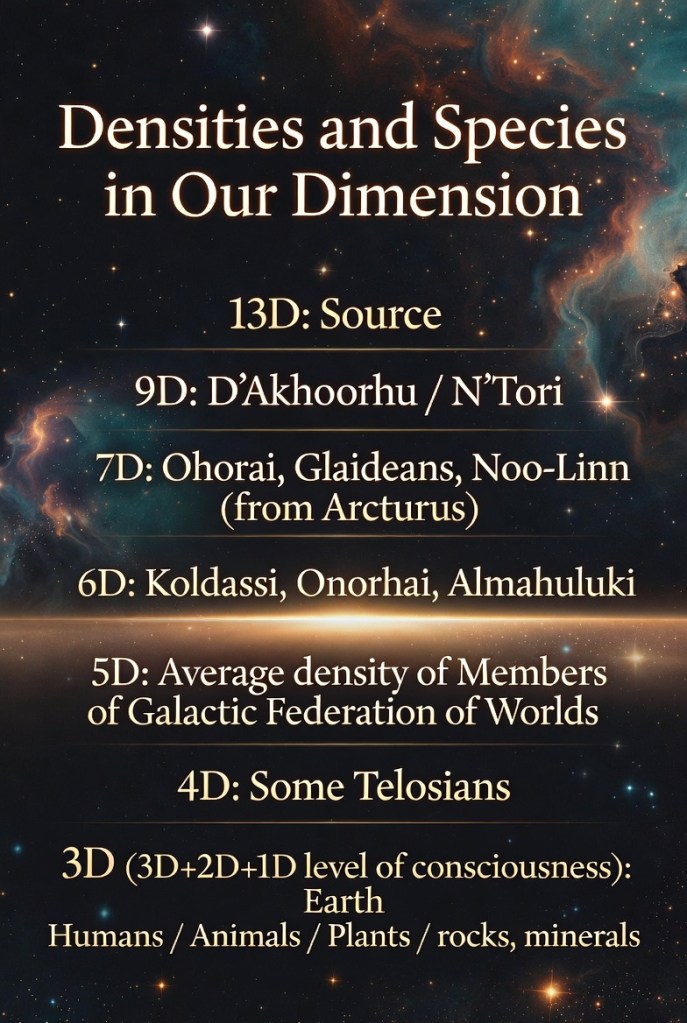
A few examples of species and their associated density frequencies (2)
PEOPLE LIVING ON HIGHER DENSITIES Within our dimension, that encompasses all galaxies that we can see, there would be people or other species that live on higher vibratory densities. In the diagram on the right hand side, you can get an impression of certain species and their associated density levels. This list can raise a few questions. We discussed a number of them in our GA Study Group (2-4).
We already talked about some of them on other pages (5-9). We have also described technology, like frequency belts, that can enable people to temporarily shift their density to a higher or lower level (10). There would even have been species that would have been able to flee from their enemies by raising the frequency of their whole species to a higher density, like the Eldaru (11).
Apparently you can become invisible for a 3D person when someone shifts to a higher density.
DISTINGUISHING BETWEEN DIMENSIONS AND DENSITIES This article, however, is not about densities, but about so-called interdimensional beings. The reason for first paying attention to this concept of densities is that perhaps many people who see beings disappear into thin air, could be seeing beings that shift into a higher density, not another dimension, which is a completely different things altogether.
INTERDIMENSIONAL PORTALS Within our framework different dimensions mean completely parallel realities or universes. We have come across quite a few species that would have arrived in our galaxy in our dimension, through so-called interdimensional portals, which would allow people to jump from one dimension to another.
In an article on Portals (12) we describe two of these interdimensional portals which would be situated in the Lyra and the Orion system. There must at least be a third one near Arcturus in the Boötes Constellation. Various species would have entered our dimension of reality through these portals. Take for instance the Ciakahrr (13) and the Anunnaki (14). The Koldassi are a special case: it seems they both live in a higher density and in another dimension, while also having a colony in our solar system (on Venus). You can learn more about this at (7).
INTERDIMENSIONAL SPECIES Let’s recap what we have described so far: there are species that exist in different densities; we can interact with other densities through technology (and probably also through consciousness/meditation skills). Then there are other dimensions that can be accessed through interdimensional portals. But what about species that can shift or jump between dimensions themselves, without the use of portals or technology?
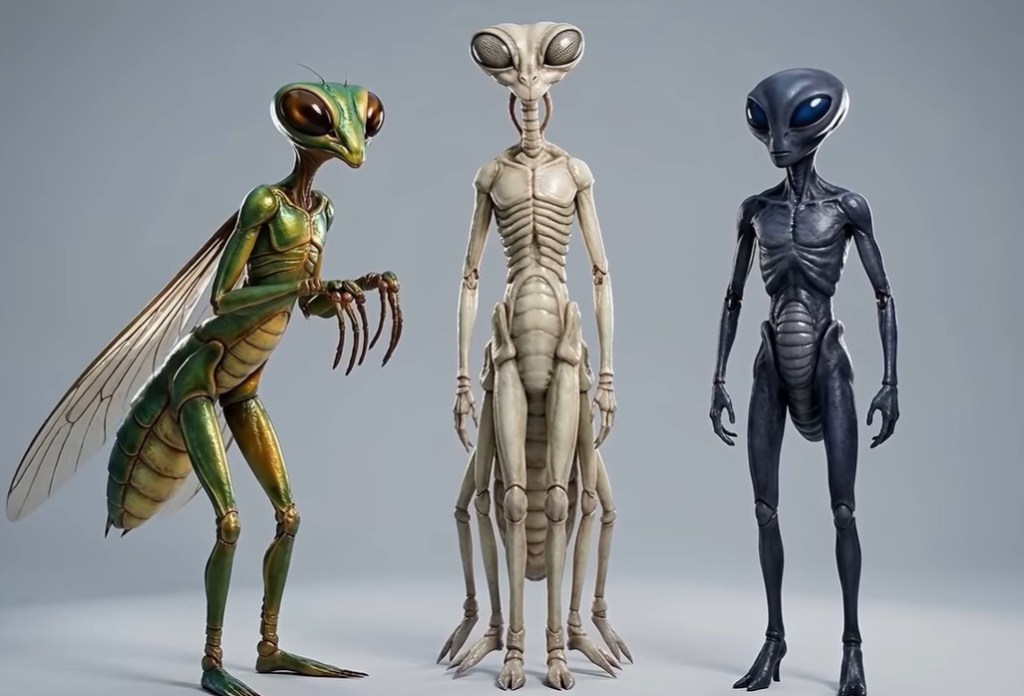
Three types of Akara (Image by Elena Danaan (18))
The Giansar would be one of the species that would somehow be able to jump dimensions on their own (15, 16). Another more well-known extraterrestrial species with alleged interdimensional features are those of the Praying Mantis kind. Let’s take a closer look at them.
THE MANTIDS You can find an article on this website that is solely focused on these extraterrestrial grasshopper species (17). Elena Danaan identifies three types of Mantids that would have their homebase in a completely different galaxy called the Sombrero Galaxy some 28 million light years from our little blue planet (still within our dimension, though).
In July 2026 Elena dedicated a part of her weekly Star Nation News episode to these Akara (18). This broadcast was the main reason for writing this page. She also writes about these Akara or Akari in her first disclosure book (19). You can head for Abigaëlle’s excellent index to reach other related mantid links (20).
When it comes to their interdimensional skills, I would like to present you with a short excerpt from this 114th episode from July 2026. In this part she describes how these beings are able to exist in different dimensions or universes at the same time. She stresses, however, that this doesn’t mean that they exist physically in those different dimensions, only consciousness-wise. They are able to ‘peek into’ other dimensions, while their body remains in one dimension.
Elena Danaan on the interdimensional features of the Akara Preying Mantis (18)
THE WHY FILES Andrew Gentile from the Why Files had made an episode on the Mantids as well, back in 2025 (21,22). Quite interesting information was shared in that video that had received nearly 3 million views at the time of writing. For the purpose of this article I would like to add this metaphor for interdimensional (or perhaps multidimensional) beings that he presented:
Elena makes a clear distinction between physically existing in multiple dimensions and peeking into multiple dimensions with your consciousness. Gentile suggests that these mantids could possible be part of more dimensions at the same time, which – according to Elena Danaan – is not what is happening, at least not as part of the multi-dimensional toolkit of these akara preying mantis species.
SOME REFLECTIONS The main aim of this article to develop a better terminology to describe these ‘galactic’ phenomena. In the GA Study Group (23) we have had a small discussion about the usual mathematical meaning of words like dimension, or what normally is meant when using density in physics. It is obvious that within this new galactic field new homonyms are created to catch these phenomena that have to do with different ‘octaves’ of matter and these complete sets of octaves within a particular reality or dimension.
When a being disappears all of a sudden….we can now ask ourselves: is that being shifting into another density, but still within our reality, or is he actually moving into a completely different reality system (dimension) altogether? We have learned that technology can be used to access other densities. We have seen how some species are said to be able to actually move between dimensions and that everybody could, in principal, with the right kind of spaceship, travel through dimensions by using interdimensional portals.
This undoubtfully is very fascinating material to explore further. If you like to talk about these matters with others, make sure to study our study group or another related group (23).
This page presents a number of extraterrestrial species that during their ‘evolution’ decided to experiment with the integration of technology in their own biological bodies. This page will function as an archive for any other such species that I might run into in the future.
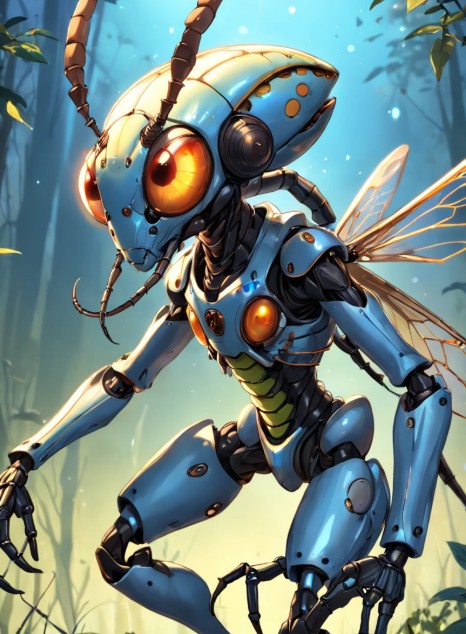
Just a random fantasy insectoid Robot (5)
THE ZORTU In the first volume of the Encyclopedia Galactica (1) we can read about the Zortu from the Apus Constellation that live on a planet in the Zort System that we know as HD131664. Elena Danaan introduces them as follows: “The Zortu are a species of insectoid cyborgs. They originated from the 7th planet of their star system as a natural biological species. However, over time, they developed a tech-based civilization that led to the eradication of their natural environment and all other species living on their world. Their hive mind consciousness merged with the artificial intelligence they created, resulting in the species becoming an artificial version of their original selves.” (1, p.49)
This process led to their organic hive-queen consciousness isolating itself from their dying matrix. As Elena points out: it is unclear where the souls of the Zortu went. Luckily this species in non-invasive and they ended up getting caught in some loop. This doesn’t like a species to envy.
THE SUB SARI Here’s another example of a species that experimented with technology. This species is not an insectoid one, but a humanoid version, even originating from the Man-system (2). Elena writes: “Moved by an exploration of the limits of human capacities, the Sari included more and more technology parts into their bodies, shfiting to become transhuman for a long while, and then in the foolish desire for immortality, they transferred their consciousness into cyborgs. The GFW counts them as valuable members but does not encourage this path of evolution for biological beings. They believe that human consciousness is not meant to embody artificial vessels.” (3, p.131)
In the Sub Sari entry in the book Elena Danaan mentions the difference with plasma beings who are able to embed themselves in spaceships (4). These plasma beings can easily adapt to these circumstances, whereas a humanoid soul can only really function well in humanoid organic bodies.
THE SEIL The Seil from the Boötes Constellation (star system HD128311) are described as ‘Techtoids’. In the first volume we can read about them: “It is not uncommon to encounter insectoid species that have fused their genetics with technology. The insectoid’s hive-mind consciousness structure allows for an easy interface with artificial intelligence. The same is true for hive minded Grays….Insectoids have this proclivity for technology and merging their biology with it, wanting to gain abilities and eternal life, always for the greater good and prosperity of the hive. The Seil do not have the best of intentions towards other cultures, and they regularly raid worlds to increase their material and living resources.” (1, p.196)
In the page on Insectoids you can learn about other insectoids who have integrated all kinds of technology into their biology. You can find out more about the ZADU there for instance (6). To read more about these nasty guys get your hands on the first volume (1).
SOME REFLECTIONS The number of species that have gone into this area of technological development appear to be rather small (luckily). If you like these kind of topics, consider joining our Telegram group (7).
Exploring the various aspects of this possible galactic reality often is a lot of fun. Who would have ever thought I would write a page where I compare the various teeth structures of species from other worlds? So, let’s have a galactic bite with some people from the Alpha Centauri star system, the Iarga and the 1986 Koldassians.
THE 1986 KOLDASSIANS AND THEIR TEETH The reason for this starry dental page is an interview between Beverli Rhodes and Dani Henderson (1). We have used an excerpt from this interesting exchange in another article as well. You might remember the remarkable story on that man who could light a room by meditating a light from his forehead (2). When it comes to Koldas there are two variants: the older variant based on decades of experiences mainly from South Africa (3), and the new variant based on the experiences by Elena Danaan (4,5). The future might shed more light on this peculiar element. I use them as two interesting separate accounts without feeling any need to make judgments on their validity.
Here’s an excerpt in which Beverli Rhodes describes what she learned about the teeth of that 1986 Koldassian she had met in South Africa:
She says that their mouths are smaller, hold less teeth and they lack the sharper (‘carnivirous’) teeth the Terran humanoids, like you and me have.
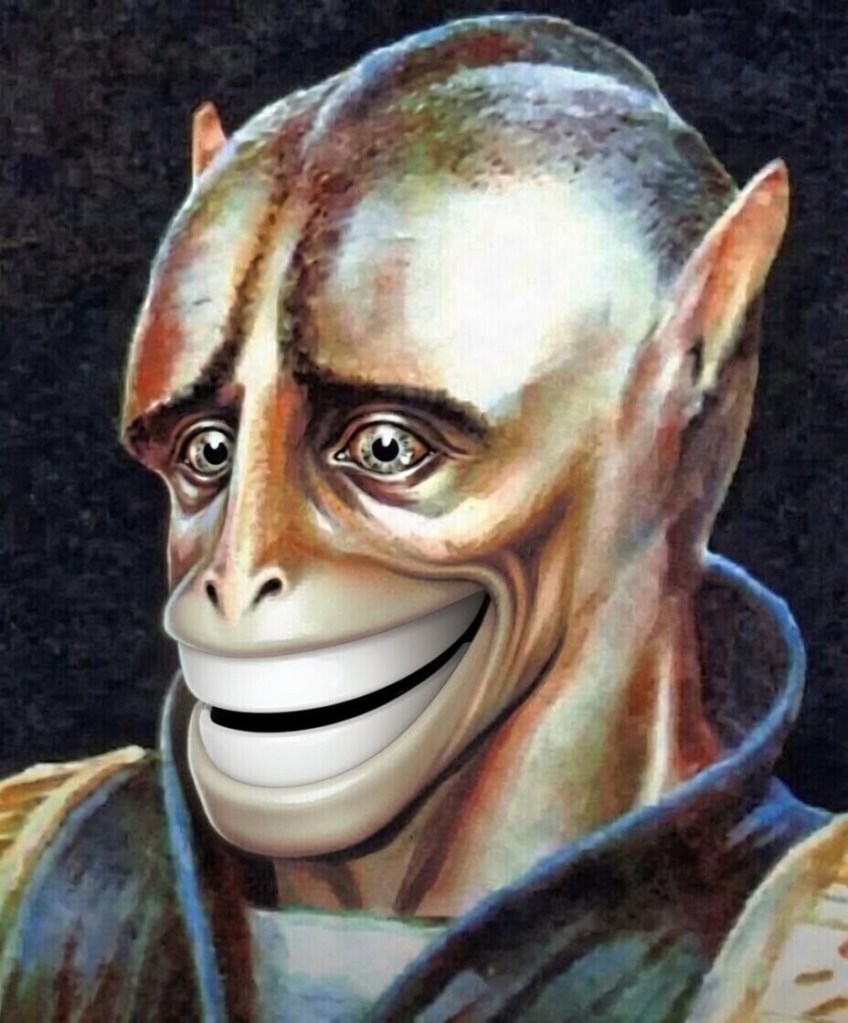
THE IARGA The Iarga are a second species that are not mentioned within the large corpus of species that Elena Danaan has uncovered. These Iarga were mentioned by Robert L. and recently as you can read on the Iarga page (6). In the 1960s they were described by Stefan Denaerde from the Netherlands in a book (7). They would all have fake teeth, but the teeth do not look like separate teeth at all. They would more look like sharp plates that are used as a kind of scissors (6).
AI-altered image. I am not sure if the Iarga person would feel flattered with this, but I just hope he can take a good joke. This adaptation is based on an image that you can find at (6)
THE CENTAURIANS David Wilcock said that he had received information on the teeth of what he called Centaurians (8). They would have less teeth than we do (only 22). Now, that we have been wondering through many civilizations in the Centaurus system, it becomes clear that calling people ‘Centaurians’ is really oversimplifying matters. It would already be a great jump in accuracy if we would move from Constellations to star systems. But of course naming a constellation is better than just saying something like ‘an alien’ or ‘an extraterrestrial’ or a ‘trans- hyper- or interdimensional’ 🙂
The teeth of these Centaurians, who probably are the Selosians from Alpha Centauri B, would also have serrated, rdiged edges and a scalloped mouth roof, at least according to late David Wilcock’s source. This is not confirmed or denied by Elena Danaan’s information. To learn more about the Selosians, see (9).
SOME DENTAL REFLECTIONS I remember Wilcock saying that the Centaurians had their own human dentist who was aware of their galactic origin, but he kept the dental logs to himself. It’s interesting to note that we portray three species here that are not from the main supplier of this webiste. When I come across interesting additional information on the teeth of certain extraterrestrial species, I will add them to this page.
If you like talking about extraterrestrial teeth join our Galactic Teeth Study Group (10).
Did these two creatures appear in Varginha in 1996?
Triggered by a Brazilian member of our Study Group (1), I finally took a deep dive into one of the world’s most famous extraterrestrial accounts: the Brazilian Varginha case. A link between the species mentioned by the eye witnesses and the description of this species both by Elena Danaan and the Russian Secret Book of Aliens (2) added another incentive to study this remarkable story.
JAMES FOX James Fox is a documentary maker who was present during a press meeting in front of the capitol with representatives Tim Burchett (3), Anna Paulina Luna, Jared Moskowitz, Eric Burlison (4) and whistleblower David Grush on June 9, 2026 (5).
In an excerpt from his contribution he refers to the Varginha case and asks the Trump administration to release the related files. He adds that the Brazilians side has said that it would declassify the case when the US decides to do so as well (6, 10).
James Fox on the Varginha case (June 9, 2026) (6)
MOMENT OF CONTACT 2022 AND THE VARGINHA CASE In 2022 James Fox released a documentary on the Varginha case called ‘Moments of Contact‘ (7). In this excellent production, Fox presents many eye witness accounts from this case that is about the sighting of both the debris of an alien craft and its likely passengers. I highly recommend watching this documentary. I will only briefly mention the main elements here. There is a witness who saw a craft with a white plume smoke crash in the South-Eastern city of Varginha in January 1996. Immediately the military came and took over the site and forced the witness to leave. Later two girls and a young woman encountered an oily brown-skinned, rather small naked being with big red eyes who was huddled against a wall. They got scared and ran away and told their mother about it.
In the documentary we learn about a military policeman, Marco Chereze, who would have caught the being out on the streets. The being was then transferred to a local hospital, where an X-ray was made before the being was moved to a local military base (Esa), where it seems the beings spent a night in the truck/van. The man who got into direct physical contact died of a mysterious infection within a few weeks. Many witnesses described this ugly smell of sulphur or ammonia that accompanied the creature. After the move to the local military there was another transfer to ‘ESPCEX’ in Compinas, which James Fox described as ‘a university where all the intellectual heavy weights reside‘ (8). This is where a plane from the US Air Force landed. Then two helicopters are said to have flown to Varginha and after their return the American plane flew away again, probably carrying the two creatures.
TWO CREATURES WITH DIFFERENT LOOKS? Three years after his first documentary on the Varginha case James Fox produced a second documentary (9), which I am unfortunately unable to watch from Europe. In that documentary Fox introduced a new Brazilian witness, Italo Venturelli, a neuro surgeon, who came forward to disclose that he had spent 4 minutes with a creature in that month of January in 1996 in Varginha. In an interview with Jesse Michels (11) we can hear him describe the being he saw:
Italo Venturelli describes his meeting with one of the beings from Varginha in January 1996 (11)
What is remarkable about his testimony is the difference with the creature the girls saw. This being wasn’t brown, oily, red-eyed with a terrible stench surrounding it. This being was peaceful, white, odorless and with lilac shaped eyes. He did have the same three crest-like protuberances and the same size as the one witnessed by the girls.
There are more arguments to assume that there actually two creatures that were caught. We can hear about a situation with a strong military presence in a hospital where a doctor was forced to make X-ray photos through a black bag that contained a living creature (12), which didn’t last very long before the creature(s) were transferred to the military base. In the account of the neurosurgeon we get a way more peaceful interaction with a creature: a colleague and friend of Venturelli (Marcos Vinicio Neves) even made a video of a small procedure he did on the being, and showed it to his family and friends.
I would seem that one creature was caught by the military policeman Marco Chereze and another one by the firemen brigade (14). One stayed in a hospital for perhaps a few days whereas the other was moved to Campinas by the military. Who caught the white one? Which hospitals were used exactly? Did the neurosurgeon contact the doctor who made the X-ray? Why did one of them have such a dreadfull stench, while the other didn’t? Could they represent different ‘races’ on their home planet? Could fear have made them produce this amonnia like smell? For more on Italo Venturelli’s testimony see (22).
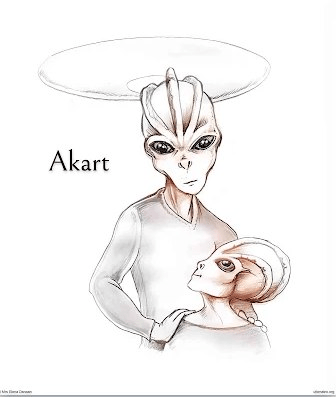
The Akart – Drawing by Elena Danaan (18, 19, p.277)
THE AKART – A SPECIES FROM THE SEXTANS CONSTELLATION The main element that made me want to explore this Varginha case was the presence of this species in both Elena Danaan’s work and in the Secret KGB Book of Alien Races (16,17). Let’s take a look at what they both said about a species that has a very close resemblance to the species in the Varginha case.
THE RUSSIAN BOOK OF ALIEN RACES In this book (17) we come across the Akart on page 18. The information we get there is the following: “They come from constellation Sextans. One of their ships crashed outside of Varginha (Brazil) in 1996. 2 of its occupants are under USA custody, after having paid billions of dollars to the Brazilian government. They have the fastest ships of any known alien race. Last sighting: February 2022, near Varginha (Brazil)…again!”
ELENA DANAAN’S INFORMATION For more background on the connection between this Secret Russian book of Alien Races and Elena’s work, read (16). In her first disclosure book (19) a lot of additional information is given on this species. Let’s take a look at a few excerpts:
“The Akart originate from the planet Okunuu Okulua (Epsilon Sextantis / ε Sextans) in the Sextans constellation. Their star system has three planets and is sometimes called the Akart system. They are described as a small Grey-type race with distinctive features (including three ridges or crests on the head), curious and impulsive but generally not involved in abductions. They are known for scientific interest and have been linked by some researchers (including in connection to the Varginha incident) to certain Grey-like beings. “
She says that they have big dark eyes (she doesn’t seem to mention the color red or lilac).
“Females tend not to travel, unless they are part of the upper scientific class….They lay eggs as they are of cold blood type….A female Akart can lay up to six eggs in her lifespan. They do not live very long compared to many other species in the federation but maybe just a bit older thn the Terrans, over a decade or two.
Their technology is not among the more evolved ones but they know astral travel……they eat flesh. “They wear clothes, but not always. For interdimensional travel for instance, no clothes are required because of their peculiar method to do it; they know how to transfer their light being and incarnated bodies, bot not clothes either any non-corporeal object. That is their way of doing. That is often the reason why the interdimensional ships crews are unisex….They have oval, grey metallic ships with no window.” (19, p.276)
A statue in Varginha, featuring one of the Akart (21).
Elena apparently couldn’t confirm the claims in the Russian book about them having the fastest ships or about information regarding any payment by the US government for these beings to Brazil.
SOME REFLECTIONS So what to make out of this intriguing case? First of all we all need to be very grateful for all the work James Fox has invested in this topic. I think the huge amount of witness testimonies regarding the craft, the sightings of the creatures and the involvement of the military (and firemen) and even the United States airforce, makes it a compelling case. It would be great if Fox’s plea to include this case in one of the upcoming releases from the Department of War’s UFO Files (20). The former defense minister of Brazil has promised to release their part of the files if the US decides to release their information (10).
Until then we have to accept that we only have partial information: was there indeed a white and a brown creature? How come one of them smelled so extreme? Where is the video of this small hospital procedure? Where are the photographs?
What to think of the description by Elena Danaan of this species? Could there be any truth to it? It seems they ended up in the Russian Book of Alien Races only after they had shown up in Varginha. Who provided the Russians with the information on their constellation of origin and their name?
Let’s just hope we will get more information on them in the near future. If you like to explore galactic topics like this, join our Study Group or a related group (23). You can find a separate thread on this case with additional information at (25).
This websites plays around with the idea that our universe is filled to the brim with all kinds of species. In nearly 550 articles I have described many aspects of their lives, alliances, histories and their interaction with us. I like to take a look at them from all kinds of angles. This article gathers a number of species that would be carnivorous hunters. How do local federations or the Galactic Federation of Worlds (1) deal with this phenomenon?
HUNTERS IN SPACE When thinking about hunters in the universe I was reminded of the fictional characters called the Hirogen from the Star Trek series (2). Their hunting practices seem to be ingrained in their genetics. In Elena Danaan’s Encyclopedia Galactica we get introduced to a number of species who also cannot shake this hunting habit. Let’s see what we can learn about them.
The Morekat (snapshot taken from SNN 73 (4))
THE MYZIAL-MAYARKO Elena introduces a civilized reptilian culture from the Beta Centauri Ab star system in her second volume of the Encyclopedia Galactica (3). When it comes to hunting she writes: “The Myzial-Mayarko are carnivorous mammals that hunt other species for food. However, they respect the interplanetary agreements made by the Midar Federation of Planets: Oraa Midari Shaari.
These non-belligerence agreements securing neutral zones between the cultures of the Midar star also stipulate that visitors from outside the star system are included in this protection clause, because they are not indigenous to Myzial. The Mayarko are only allowed to hunt on their own planet. They maintain vast natural reserves where inferior species are farmed but left in the wild so that the Mayarko may hunt for sport as a cultural tradition.” (3, p.124)
THE MERIAL This kind of agreement can also be found in the Marzari star system in the Carina Constellation. On planet Marza we can find the Merial: “The Merial are hunters with a carnvirous diet. In exchange for protection, the Matshuri Federation of Planets does not allow them to hunt outside the atmosphere of their planet. To secure this request, the Merial were offered a unique and lucrative commercial stake in the Matshuri Federation’s trade agreements with others worlds.” (3, p.39)
This species is not a member of the Galactic Federation of Worlds (1).
THE MOREKAT The Morekat have appeared on this website before in a few other articles, like the page on Green Skinned People (5) and the page on Copper Based life forms (6). You can watch a video on them at (5) or directly at (4).
Within the context of this current article the following information is relevant: “The Morekat are carnivorous hunters. They will not hesitate to kill other species for food, but only on their own planet, Luyu and its moons, or outside of the jurisdiction of their own star system. This is due to their strict agreements of non-interference with the Sheymangenkuk, which forbid preying on other species inside of the agreed safety zones. The Galactic Federation of Worlds disapproves of such practices, although an exception exists if the hunt is not for trade and is solely for the natural needs of the species. The Galactic Federation of Worlds permits regulated food chain requirements in certain cultures, and the Morekat are one of them.” (7, p.265)
WANG WONKATAD-MARKUK Just like the Myzial-Mayarko this species lives in the Midar system (Beta Centauri Ab). They have made a moon of the Myzial planet their world. These Reptilian Saurian beings have a remarkable mating ritual….”because the female is always hunted. This is not due to social tradition, but because fear produces a chemical in her brain that activates her fertility. For a limited time, a matrix forms in her womb, waiting to be fertilized. Several dozen eggs can be produced from the same clutch. This peculiar mating ritual is noteworthy because fear is an essential triggering factor.” (3, p.126)
SOME REFLECTIONS I like the variety of species that would inhabit the universe. This article is meant to present just one of the many aspects that you can find when studying these species. Whenever I come across another hunter species, I will add them to this page. If you like exploring galactic matters with others, I welcome you in our study group, or in a related group (8).