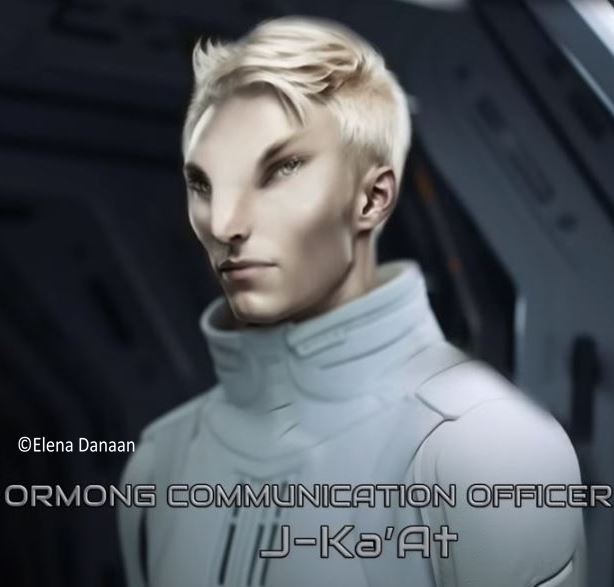
In Star Nation News 24 (1) we were introduced to J-Ka’at ‘Ashtamir’ (2) an ‘ Ormong’-member of the Intergalactic Confederation (3). This was not the first time that Elena Danaan mentioned the Ormong. In June 2022 she had already described one of the members of this species that lives in galaxy NGC7252 which we can see behind the Aquarius Constellation. In that particular video, that was part of her earlier ‘contact series‘ (4), we can hear Elena Danaan tell us of her first encounter with this species. It was also related to the Moon Pods. Would she have described the same Ormong Engineer then?
Elena Danaan describes her first encounter with an Ormong, back in June 2022 (5)
The Ormong did not donate any of their DNA to the original primate tens of millions years ago. You can find a list of species that did contribute their DNA on another page (6). You can find out a bit more about the Ormong in Elena Danaan’s books from 2022 (7) and 2024 (8).
In the Seeders (7, pp.108-109) she writes: “Species and appearance: Human – 6 Ft tall – Brown skinn – Aqualine face – very slanted eyes (scientist I met on the Excelsior (9), when the Lunar Pods arrived) (10) – Communication: Vocal & Telepathic – Outposts in Sol System: Terra: South America, working with GFW (11) Ummites (12).”
Even though they don’t originate from our galaxy, the Ormong are also mentioned in her 2024 Encyclopedia Galactica (8, pp.90-91). She repeats most of the above information, but adds that “the Ormong are a peaceful society dedicated to the study and development of science.“
Join the group of Independent Galactic Explorers at (14)
On September 21, 2022 Elena Danaan published her third book, The Seeders, in which she describes her experiences with off-world people. I managed to read the book of nearly 600 pages in three days. Of course it contains a description of just about everything that happened since the publishing of her second book, We Will Never Let You Down, of which a lot was shared in her videos, and consequently in articles on this website, since september 2021.
On top of that there is a lot of new information that wasn’t previously spoken about in her videos. I think that the big step forward since the second book is the opening up to the intergalactic level. This brings new insights and it also raises new questions. This article tries to shed some light on the 22 races that contributed to our genome: how much is intergalactic, how much is from our galaxy? How much is human, and how much is reptilian, insectoid and feline?
THE INTERGALACTIC CONFEDERATION Before the publication of The Seeders we really didn’t know too much about the nature of the beings belonging to the Intergalactic Confederation (1). We were introduced to Oona, the Altean woman, who is the spokesperson of the Intergalactic Confederation. In June we got to know a person from the Ormong race (2). Elena did describe her meeting on a ship by the Intergalactic Confederation, with a drawing that was already shared in certain videos.
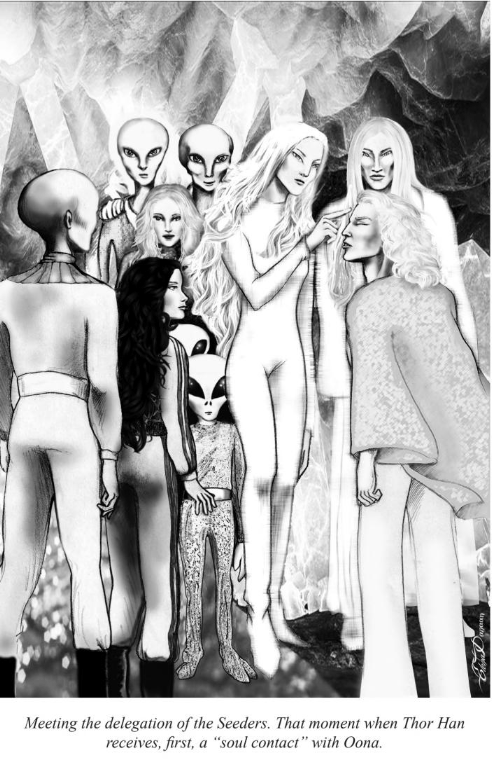
In the drawing on the left hand side we can distinguish the Alteans (on the right touching Thor Han), but also the small Gray-like beings whose kind apparently is called the La’Neel. Behind we can see the tall beings who are the original Pa-Taal (4). Right above Elena Danaan’s head there probably is a female Egon.
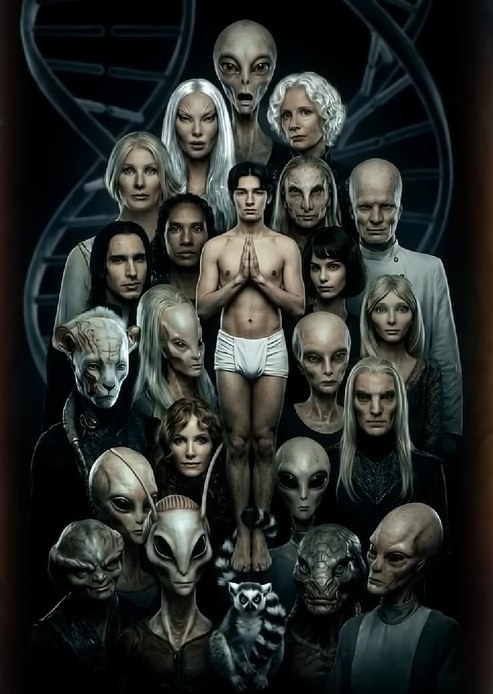
In her book 21 members of the Intergalactic Federation or The Seeders are presented in beautiful drawings. But not every member of the Intergalactic Confederation has donated its genes to the human template. In fact only 11 have done so. I only present the names and the category to which they belong: Pa-Taal (humanoid), Altean (humanoid), Elli-Yin (humanoid), Hoovid (humanoid, 15,17), Oyara Maruu (humanoid), Etherians (humanoid), Arag’un (Reptiloid), Ashai (Insectoid,16), Gray (Z-Neel, NOT the La’Neel from the drawing), Egoni (humanoid/vegetal, 5), Elyan Sukhami (feline).
The Intergalactic an galactic species that would have contributed to our Earth human DNA (screenshot from SNN 110) (19)
FROM OUR GALAXY, NATARU, THE MILKY WAY After first having had genomes from these 11 races from other galaxies we received genetic packages from these species/races from our galaxy: the Naga (reptilian), Anunnaki (humanoid/Gray, 6), Taal (humanoid), Noor(humanoid), Ahel (humanoid, 8), T-Ashkeru (Sirius B, humanoid), Selosians (Alpha Centauri B, humanoid, 9), Ummit (10) and Meton (11) subgroup (humanoid), Ohorai (12, humanoid), Grays (Eban, Xrog, Do-Hu, Solipsi Rai, Kiily Tokurt (13).
This makes a total of 21 races. The Pa-Taal would have started their genetic insertion on a Lemur-like being, which would have been the first primate on which the genes of all the other races would have been built.
SOME REFLECTIONS So we finally know on whose 22 packages our genome is based. One animal (a Lemur), many humanoid species (15, including the Anunnaki), some Gray races (2 (and the Anunnaki, but I won’t count them twice), or more since various groups are mentioned), Reptiloid (2), a feline (1) and even an insectoid race from another galaxy.
This raises a few questions. For me the biggest question is: how are the Gray, Reptiloid, Feline and Insectoid genes expressed in our very humanoid looking body? Does this imply that we are able to tune into the Naga, certain Grays and insectoids when all our DNA would get activated, or at least from those who have these lines in their genetics. How does this relate to our human future on Earth, when we have these other genomes in our system?
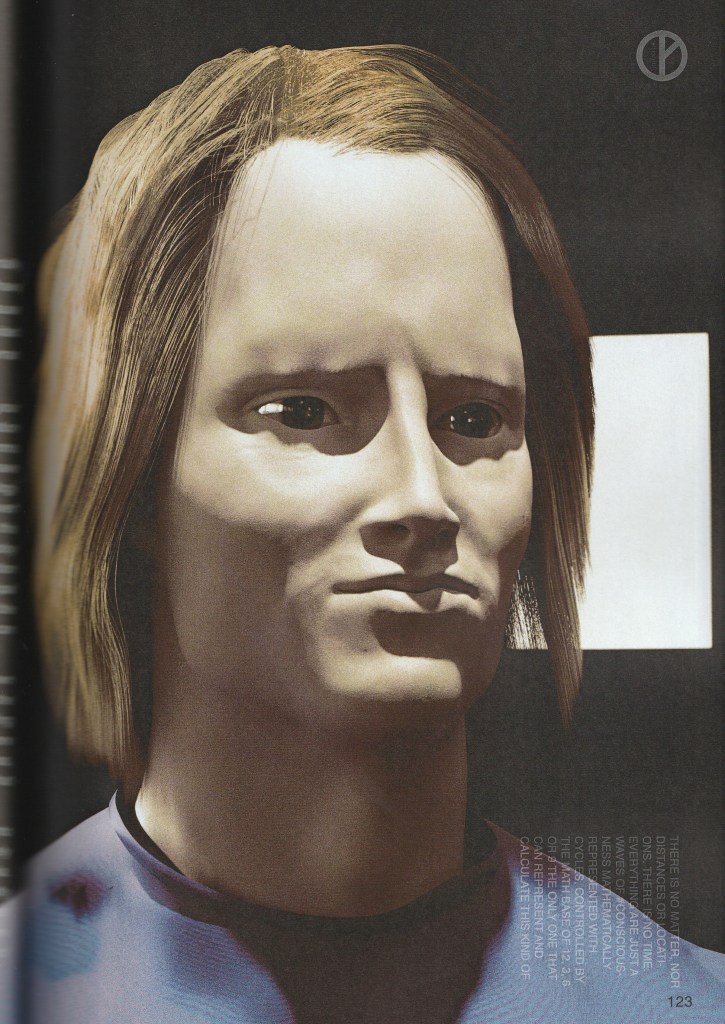
The Ummit (10), Image from ET-species (14)
In the book it is also implied that souls from various worlds need some resonance in the genetic household of the body they incarnate in, meaning that for an Arcturian (Ohorai for instance) soul, a body that has got some Ohorai-genes activated is needed. Apparently there has been no hybridization with the Andromedans, so would not participate in the star seed envoy program.
What seems to be important is that the 24 seeders are NOT the 24 seeders of the Intergalactic Confederation. Only 11 of them are our Seeders. Nearly half of those who are our Human Seeders are from this galaxy. Much more can be said about all this, but I would say this is enough for one article. Please share your thoughts below.