podcast version of this article
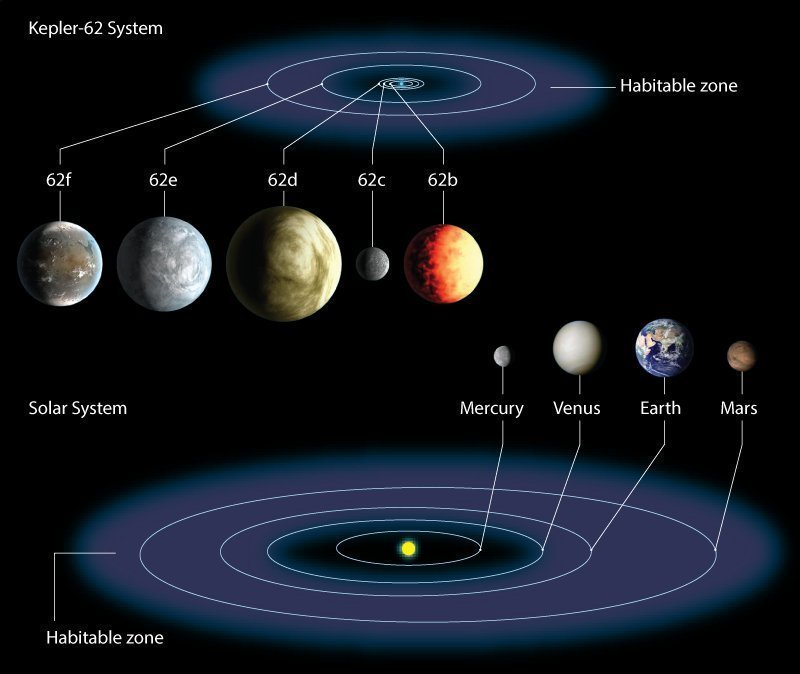
On this website we explore all kinds of civilizations and species from many star systems, mostly from within our own galaxy. In earlier articles I focused on the humanoid people called the Taal (1), The T-Ashkeru (2), and the Selosi (3) for instance. This article provides an overview on one of the orginal humanoid species that would have been seeded in the Kepler 62 system (4), namely the Noor.
THE NOOR
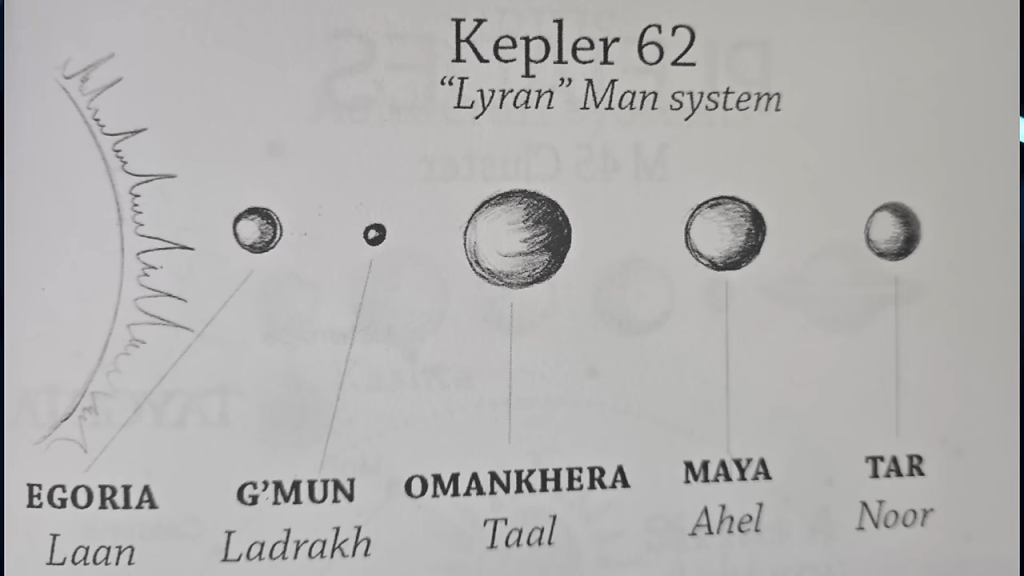
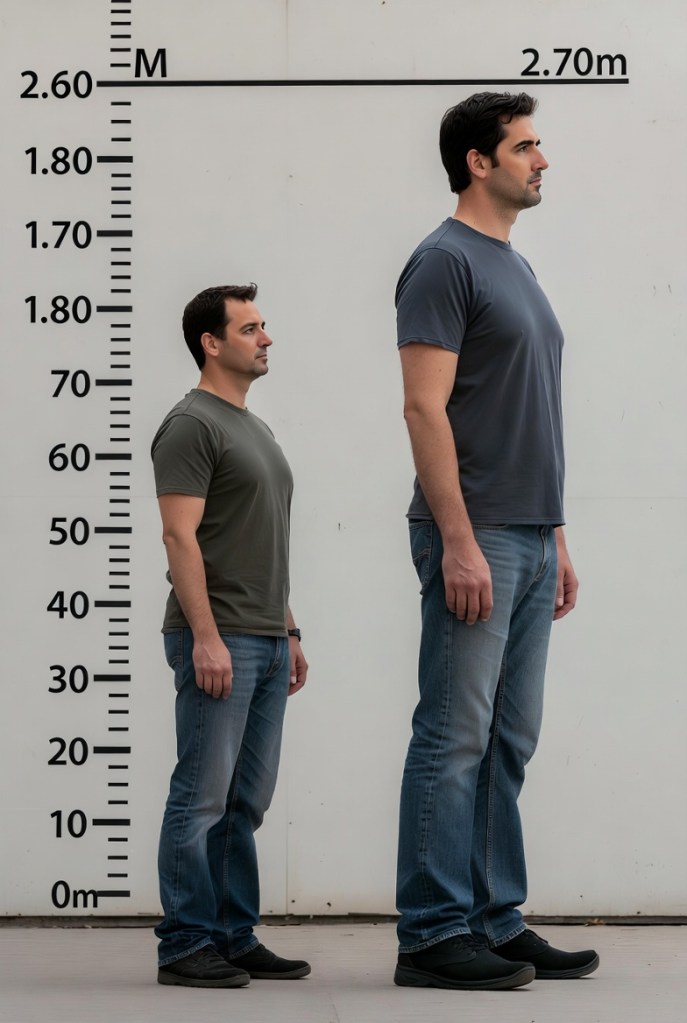
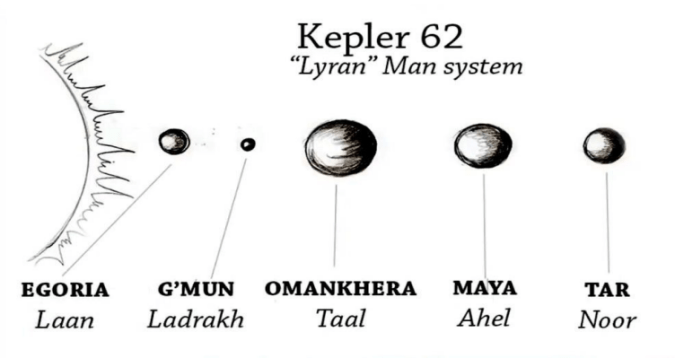
Four main humanoid species spread out across our galaxy, mostly as the result of the raid of the Ciakahrr (5) on their home world in the ‘Man-system’ (4) in the Lyra Constellation. As you can see in the image below, the Noor are from the 5th planet in that star system, called Tar. An important characteristic of these people is that they are quite tall, some 9ft (2.7 meters).
Their genomes would also have ended up in humanity’s genomes, somewhere in our past (6). Let’s see what we know about where they all settled (7). It’s not yet clear when exactly this great exodus from this star system in the Lyra Constellation occurred.
As so often, each colony has its own story and background. Often people live that long on a certain new planet that their appearance changes due to environmental conditions and sometimes even because of some conscious genetic alterations with the genomes of the locals on that particular planet. They eventually take on a new name to identify themselves with. What follows are many of these accounts of Noor descendants.
THE DAHL FROM BETA CENTAURI
I decided to write this Noor overview after I got to know the Dahl in my journey through the second volume of Elena Danaan’s Encyclopedia Galactica (11). These Dahl had already been mentioned in Elena’s first book (10, p.123). The Dahl moved from their homeworld in Kepler 62 before the arrival of the plundering Ciakahrr. They were a branch of the Noor royal family, who were called the House of Dahl. We can read: “After an altercation with the royal house that resulted in their banishment, the Dahl were forced to leave their planet and find a new destination to establish a colony.” (11, p.116)
They established their own flourishing civilization and didn’t feel any need to join any federation; they chose to mind their own business. They are not part of the Galactic Federation of Worlds (12). You can read more details about them in (11).
In August 2026 (32), Elena Danaan described a dinner that would have taken place on the XLR6, a mothership of the Galactic Federation of Worlds (12), with Jezya, a Kiily Tokurt (33) and many high officials of the ship. One of them was a Dahl from the Beta Centauri system. In response to Jezya’s arguments related to how harsh conditions can make civilizations pay less regard to ethics, he said that their people have been through very daring conditions for 3,000 years, which made them adapt certain laws that may seem unnecessarily tough. Listen Elena describe it herself:
A VISIT TO EARTH SOME MILLION YEARS AGO
In the Dahl section we can read that a Noor civilization already visited our planet a million years ago. We have heard about another Kepler-62 civilization before, that also would have paid our world a visit around that time, namely the Laan. For more on this aspect, see (13).
THE ASBAN-HU
A Noor colony thought they could establish a new colony in the Rigel systems in the Orion Constellation, together with some Ahil neighbors from Maya, the fourth planet in the Kepler 62-constellation. This, however, didn’t end up very well. They were terrorized by a nasty group of Reptilian species, called the Grail, who even forcefully genetically altered them into some slave-race. You can find all the details, including the recent positive turn of events at (14).
THE PUXHITY AND THE OLMECS
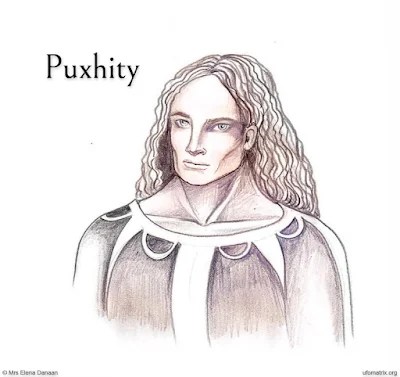
One Noor colony that fled the Lyran Wars (15) asked the Ozman (16) on a planet in the Vega system if they could share their planet with them, and the Ozman welcomed them. They peacefully co-exist. They started to call themselves the Puxhity. We are told that they have developed red hair. You can find a separate page on the Red Haired Giants elsewhere (18).
These people would also have the ones that we got to know on Earth as the Olmecs from Central and South America. Some 2,000 Puxhity would have lived on our planet at a certain moment in time. The name ‘Olmeeka‘ is the local name of the star that we call ‘Vega’.
We mentioned the Puxhity as well on the page that is dedicated to species that are related to the Vega star system (19).
THE NOOR IN THE TAYGETA SYSTEM: THE ALKHORHU
In the Taygeta (Ashaara) star system in the Pleiades we can also find a Noor colony. This star system also houses an Ahel colony on a planet called Erra (20) and a Taal-colony on the planet T’Mar (10, p.337). The Noor live on the fifth planet called Alkhorat and they took on the name ‘Alkhorhu‘ (10, p.258). Here’s a bit more about this colony: “The Alkhori live as long as the Ahil and Taali, that is to say between 500 and 700 [earth] years, but a genetic alteration occurred due to the successive changes of habitat conditions. You remember, the Noori people like to travel. This unfortunate alteration is such that their internal organs fail as they do not grow as fast that their body envelops. In general the heart fails first” (10, p.258).
Well, let’s hope this condition is not very frequent and that they will manage to deal with this issue soon. We have heard a lot about great geneticists in this galaxy.
A NOOR COLONY IN THE LYRA SYSTEM: THE ELHAZIEL SYSTEM
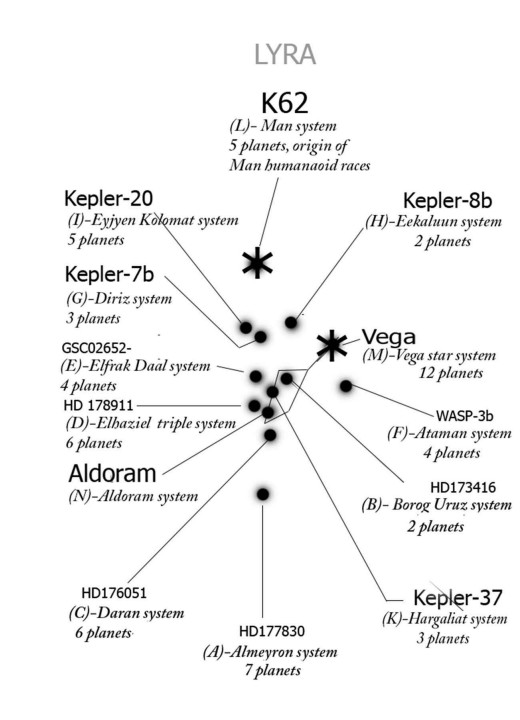
We don’t know a lot about this Noor colony in the Lyra system. They are briefly mentioned on page 190 in A Gift from the Stars and that’s about it. Perhaps one day we will learn more about them.
THE METON FROM PROXIMA CENTAURI
I was surprised to learn that our well known Metoni from our neighbors in the Proxima Centauri star system. The Meton are well known guests on this website. “Metoni are of the ‘Noor’ Lyran group-species. They are tall, non-belligerent humanoids, whose lifespan reaches up to nearly 2000 Terran years.” (10, p.124). You can find out more about them in various articles (22-25)
THE ELDARU FROM PROCYON
In a previous article (26) we already mentioned the Eldaru, a Noor colony that fled the Rigel star system in the Orion War where they were attacked by the Grail (just like their fellow Noori, the Asban-Hu (see above)). They found refuge on the fourth planet in the Procyon system, where the Grail also managed to track them down. You can read about the impressive way they succeeded in evading these Grails at (26), or you can get an idea of it by reading about the Sattar in the next section.
THE SATTAR FROM THE CAELUM CONSTELLATION
A star system that we have categorized as ‘ Wasp 159’ in the Caelum constellation houses the Sattar, who are related to the Noor Eldaru (see section above). “Like their Procyon relatives, the Sattar have the ability to jump frequencies, appearing and disappearing at will. This can be quite disconcerting if you are not used to it. They are a peaceful culture interested in science and cultural diversity.” (27, p.238).
THE OROGUNI FROM THE AQUILA CONSTELLATION
On the star system ‘HD 183263’, locally known as Sayuni, we can find the Oroguni, a human culture whose origin is unknown, although it is hypothesized that they are probably related to the Noor. It must be because they are 7 feet taal, have pale skin and have red hair. “The peculiarity of these people is that they live a cold methane atmosphere and must wear helmets when visiting carbon-based cultures.” (27, p.106)
What would their biology look like, if they are not carbon-based? We have explored species that are said to be silica based (28), and copper-based (29). Sometimes it turned out to mean that their blood cells use copper or silica instead of iron, like we do. I wonder how methane has influenced these Oroguni.
THE ONOORI IN THE KORENA SYSTEM IN THE BOÖTES CONSTELLATION
In the first volume of Elena’s Encyclopedia Galactica (27) we are introduced to another red-haired Noor colony, namely the Onoori. They also fled from the K62 Man System after the Lyram Wars. “These Noor colonists [8 foot tall], the Onoori, left their world, Tara (or Tar), in a small ship carrying only twelve of them. Ronan IV was a world inhabited by primitive cultures who greeted the celestial visitors with some awe and some fear. Over time, the Onoori developed cities, a space fleet, and became a prosperous and powerful civilization. They are members of the Galactic Federation of Worlds.” (27, p.206).
THE AMAHEL FROM CEPHEUS
In the Cepheus Constellation (11, p.163) you can find the Amahel who are described as a hybrid of Noor, Ahel and some human species called the Ologongë from Orega which is part of the Opiuchus Constellation.
SOME REFLECTIONS
Whenever I come across another Noor-related species, I will add them to this page. It is obvious that they have been around in our galaxy. The huge Noori were also mentioned in the context of the ‘order of introduction’ of the various species in our process of getting acquainted with extraterrestrials (30). After the Selosians, the Noori would be part of the second group of humanoids that look different than we do, but not extremely different, yet.
So much for the Noori. If you would like to reflect about these extraterrestrial matters, be sure to join our Study Group (31).
FOOTNOTES
(1) The Taal and their Colonies
(2) The T-Ashkeru and their Colonies
(3) The Selosi and their Colonies
(4) The Kepler 62 Man System: Then and Now
(5) The Ciakahrr
(6) Our Galactic and Intergalactic Genomes
(7) In preparation for this article I created a thread in the Galactic Anthropology Study Group
(8) The Kepler 62 Star System (snapshot from SNN 57 (9), also at (A Gift from the Stars (10), p.337))
(9) STAR NATION NEWS 57 ~ 16 12 2024
(10) Danaan, E. (2020) A Gift from the Stars (the image can be found on page 337).
(11) Danaan, E. (2025) Encyclopedia Galactica, volume 2
(12) The Galactic Federation of Worlds
(13) The War between the Laan and the Anunnaki
(14) The Return of the Asbaan-Hu to Oriban
(15) What Came First? The Lyran or the Orion Wars?
(16) The Ozman as Skillful Peace Ambassadors
(17) The Puxhity – Descendants of the Noori Legacy on Planet Ozma in Vega
(18) The Red Haired Giants from a World near Vega (and other worlds)
(19) Species Related to the Vega Star System in the Lyra Constellation
(20) We once talked a flower from this planet at: The Vanilla-like Smell of Flowers from Erra. You can find more links on Erra on that page.
(21) It was in a transcript from Sam Mast that I found this Lyra diagram. You can also find it at (10, p.336). I suppose Elena picked out these star systems in the Lyra system because they contain planets that harbor intelligent star faring life.
(22) Having a Life Span of Two Thousand Years – The Metoni in the Proxima Centauri System
(23) Delving into the History of the Meton: Venus, Earth and Mars (and some dinosaurs)
(24) On Meton Walls, Windows and Doors
(25) A New Colony from Alpha Centauri to Settle on Mars
(26) The Eldaru, the Sattar and their Ability to Jump Frequencies
(27) Danaan, E. (2024) Encyclopedia Galactica, volume 1
(28) Silicon-based Humanoids
(29) Exploring Copper-based Life Forms
(30) In which Order will Extraterrestrials Introduce Themselves to Us?
(31) Telegram groups: Galactic Anthropology (general updates), Galactic Anthropology Study Group (most active group with hundreds of separate discussion topics) Alex Collier Study Group and the Galactic Anthropology Library. Elena Danaan also has her own telegram channel and even her own open telegram chat group. Dr. Salla also runs a Telegram Group. Do you want to help with studying and exposing the Deep State? Join the Gondolath Globalist Narratives Study Group or visit the website: Gondolath Project. You can also follow the alternative side of current events at the Laura Aboli Archive. There’s also a huge Diddy and Epstein group that you can join. Galactic Anthropology tries to spread both the disclosure information and the Deep State Explorations at Reddit, Facebook, X (Twitter), on VK, Youtube and on TikTok. Hope to see you soon in one of the groups! Like, share and subscribe.
(32) STAR NATION NEWS 120 ~ 31 08 2026
(33) The Kiily Tokurt